Continuing the Work: Super Angels II

Continuing the Work: Super Angels II

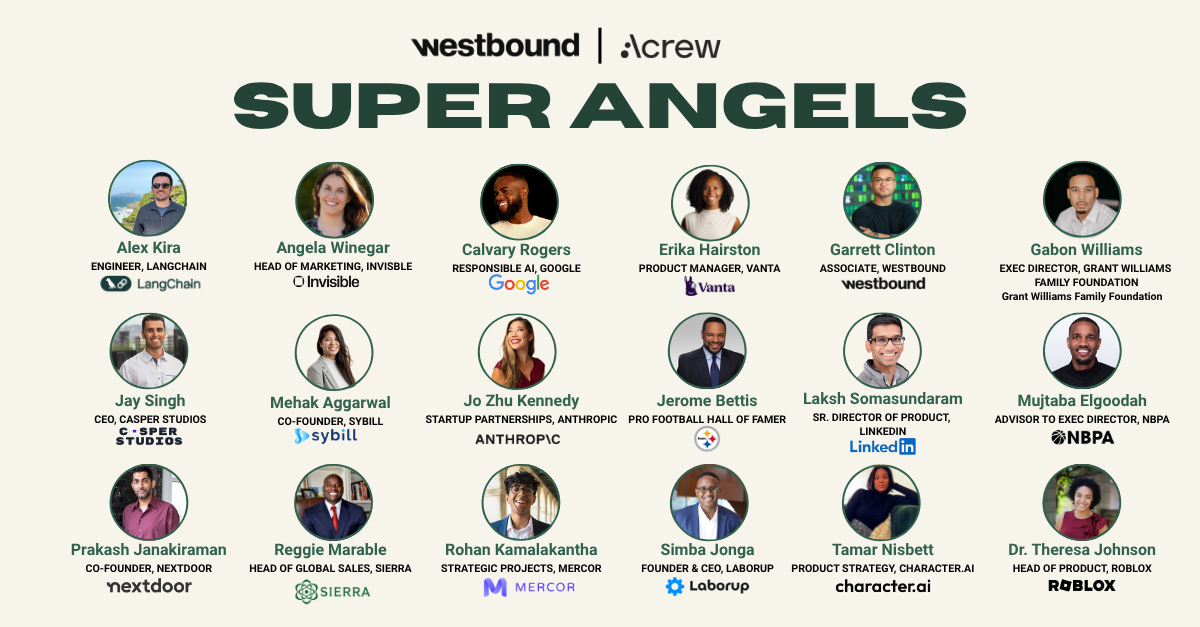
We’re excited to announce the second cohort of Super Angels, a program that gives founders early access to capital and mentorship from some of today’s most experienced operators.

Backed by Acrew Capital and Westbound, Super Angels invest directly and help founders move faster from idea to traction, providing hands-on guidance in the earliest stages of company-building.

At its core, this program gives founders:

  • Early access to capital
  • Hands-on support from operators and domain experts
  • A direct bridge into the Westbound and Acrew networks

The Super Angels bring deep expertise, product judgment, and networks across technical and go-to-market domains to help founders grow from day one. If you’re building in our focus areas, we’d love to meet you.

Westbound State of the Market 2025

Westbound State of the Market 2025

10 stats defining VC this year, brought to you by Carta

At this year’s Summit, I asked Carta’s Peter Walker to cut through the noise and share this year’s venture markets data. His answer? The rules of the game have changed and they have the data to prove it:

1. Teams are staying leaner for longer

Average full-time, equity-holding headcount is shrinking at every stage. Seed teams have fallen from 6 to 5 employees (-16%), Series A from 20 to 15 (-9%), and Series C from 101 to 79 (-19%). Founders are keeping burn low and hiring sprees at these stages are no longer a status symbol.

2. Fewer companies are making it to Series A

The graduation rate from Seed to Series A has dropped sharply since 2021. Many recent cohorts see sub-15% progression within the first 18 months: a sobering stat for early-stage founders and their investors.

3. The fundraising clock has slowed

The trend of raising a new round every 18 months is fading. Median time from Series A to B is ~2.1 years, and B to C stretches to 2.5 years.

4. ARR bar for Series A has skyrocketed

B2B founders are expected to show far more traction: median ARR has grown from $1.3M in 2021 to $2.9M in 2024, and top quartile ARR has jumped to $6.8M.

5. Bridge rounds are becoming standard practice

Bridge financing isn’t just for distressed companies anymore. In Q1 2025, 46% of Seed rounds were bridges (up from a 35% average since 2020), and Series C bridge rounds jumped to 28%. Even performing companies now need more runway to  get to the higher bar.

6. AI SaaS still commands a valuation premium

At Series A, AI SaaS startups are valued 25% higher than their non-AI peers ($54M vs. $43M). At Seed, the premium is 41% ($18.1M vs. $12.9M).

7. Not all sectors are created equal

Cybersecurity, AI software, and hardware lead both valuation and raise size benchmarks at Seed. Social media remains an outlier, raising large rounds despite macro headwinds.

8. Series A valuations are near record highs

Median pre-money valuation in Q1 2025 reached $49.5M, second only to the 2021 peak. Investors are paying up for companies that clear the higher-traction bar.

9. Seed valuations have never been higher

Despite slower Series A progression, median seed valuations are at an all-time high of $15.6M. This was surprising for investors and founders in the room, but the data backs it up.

10. Capital flows have normalized

The late-2022 spike in venture funding – fueled in part by generative AI’s breakout – has cooled. Capital raised per quarter now hovers around $23B, far below the 2021 peak of nearly $68B.

The takeaway for founders and LPs: This is the “higher bar, longer climb” era. More proof points are required to raise, the path between rounds is longer, and sector dynamics matter more than ever. In practice, that means:

  1. Planning for longer fundraising cycles: Median time between rounds now stretches past two years. Runway management is non-negotiable.’
  2. Traction is the new currency: With ARR expectations and sector benchmarks higher, hitting milestones before raising isn’t optional.
  3. You need to position with purpose: A premium in AI and cybersecurity shows that markets still reward clarity and category strength.

The winners will be those who conserve capital, hit traction milestones, and position themselves in markets where the premium justifies the pace. At Westbound, we help founders understand how the game has changed and help them build with the discipline and category clarity to win in this new era. If this is something you’re navigating, we’d love to chat.

Values As a Compass: Field notes from Summit 2025

Values As a Compass: Field notes from Summit 2025

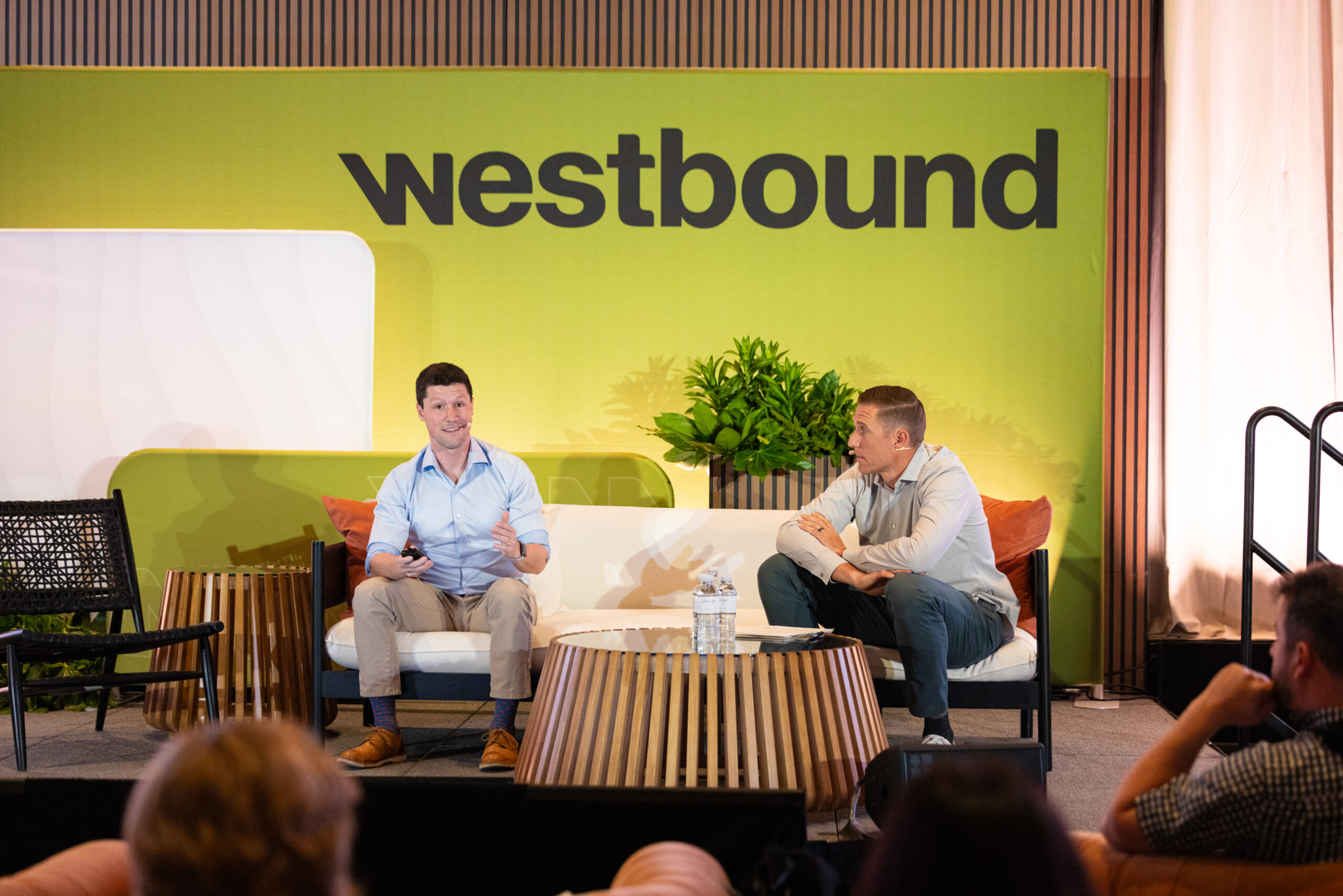
Last week, our community of founders, builders, investors, and change-makers gathered for my favorite Westbound tradition: our annual summit. Over two days in Healdsburg, advisors, investors, and operators shared their expertise and founders provided fresh perspectives, accelerating everyone’s growth. 

My journey from Venezuela to Northern California twenty-three years ago taught me that while your surroundings can shift overnight, your values travel with you. 

This is not unlike what leaders experience as their organizations grow and their roadmaps blur. In times of uncertainty, you need more than a playbook. You need a North Star and principles for how you will navigate towards it. This year’s summit focused on exploring how values shape stronger daily decisions and give organizations a lasting competitive edge:

  1. Clarity amid turbulence: Shared values can help teams cut through noise and analysis-paralysis;
  2. Execution speed: These same principles collapse decision-making time on a daily basis. Organizations with this kind of alignment move faster without sacrificing integrity; and,
  3. An enduring advantage: This isn’t just a feel-good mantra. Data shows this is how you win.  A multi-decade McKinsey study of 1,000 organizations found that companies with healthy values, vision and strategy-aligned cultures dramatically outperformed peers on total shareholder return. 

Many of our speakers spoke about how they’ve brought our Summit theme – Values as a Compass –  to life throughout their organizations and careers:

  • The San Antonio Spurs’ R.C. Buford lifted the curtain on how the team’s basketball philosophy shapes their entire organization and has guided them through multiple championships; 
  • Character.AI’s Erin Teague, Sierra’s Clay Bavor, and Next Play Ventures’ Brian Rumao discussed how to scale AI-native companies and how team structures shift when models sit at their core;
  • Jeff Weiner shared how he translated long-term vision into everyday operating principles during his 11-year CEO tenure at LinkedIn with his vision-to-values framework;
  • Visa’s Frank Cooper and Sixth Street’s David Sutphen unpacked the habits behind durable brands, from full immersion in your industry and cultivating taste to hiring in the age of AI, and
  • Acrew’s Theresia Guow unpacked how her values-first investing ethos – honed from Accel to starting Acrew – guides everything from taking a bet on a founder to building winning teams. 

In breakouts, Westbound Network industry experts shared practical tactics, from go-to-market frameworks to resilience rituals, that our community can put to use immediately. Special thanks to Wemimo Abbey, Jane Alexander, Steve Benjamin, Maria Colacurcio, Somesh Dash, Joelle Emerson, Prakash Janakiraman, Fern Mandelbaum, Danielle Naftulin, Satya Patel, James Slavet, Mike Smith, Peter Walker, and Russell Wolff.

It was a privilege to bring the kinds of conversations we typically have one-on-one in founder coaching sessions into a community setting, where we could learn from and with each other. That’s why we offer culture coaching to help our founders codify and operationalize their values, and hire with them in mind.

Finally, we’re deeply grateful to our sponsors who partnered to make this event successful: AWS, Carta, Cleary, Esusu, Latham & Watkins, MetLife, Ramp, SVB, Visa, and Wilson Sonsini.

Questions, reflections, or speaker stories to add? Email me or tag @WestboundEquity so we can keep amplifying the wisdom that surfaced in Healdsburg.

# # # # # # #